






Scroll For More







Score (97)


This Former News Anchor Raised More Than $222,000 for an Elderly Veteran Pushing Shopping Carts
Former news anchor Karen Swensen spotted 90-year-old Air Force veteran Dillon McCormick pushing shopping carts in sweltering Louisiana heat on Memorial Day. Moved by his story, she started a fundraiser for him which quickly raised over $244,000. McCormick plans to donate a quarter of the money to his local church and has no plans to retire, saying "If you stop working, you will stop living." The community's united response showed that people can come together for a good cause regardless of their differences.


Score (98)
High School Teens Repair Used Cars to Donate Reliable Transportation to Single Moms
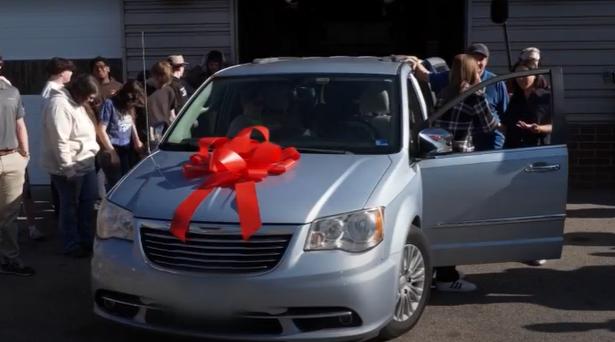
In one Virginia auto shop, the cars are headed somewhere simple and life-changing: to single mothers who need a way to get to work, school and medical appointments. At Louisa County High School near Richmond, a group of students has been repairing used cars that are then given to local single moms. The students are part of a trade program tied to a partnership between the school and a local non-profit, Giving Words, which fixes used cars and donates them at no cost. Giving Words was founded in 2018 by Eddie Brown and his wife, Ginny. Brown said the couple came to understand that single mothers needed help in several areas, and transportation rose to the top. "What we learned was transportation was the first thing," Brown said to Today. "Without transportation, you don’t have access to a job, you don’t have access to education, you don’t have access to medical needs." What began in Brown's driveway has since grown across Virginia. Brown said the charity has received more than 60 donated cars to date. Giving Words also works with local dealership Carter Myers Automotive to coordinate the donated vehicles. Now, students, including Owen Yarrington and Stephen Smith, are among those helping get the donated cars back on the road. For Smith, the work carries real pressure because someone else will depend on the vehicle being safe to drive. "So it is a lot of pressure because you had to do it right and you have to make sure everything’s torqued to spec so nothing falls apart," Smith said. Even with that pressure, Smith said the work is also enjoyable. "It's a lot of fun too," Smith said. Yarrington said the handover moments stay with the students, especially when they see what the cars mean to the women receiving them. "When they tear up and cry it makes you want to tear up and cry," Yarrington said. The students are guided by Shane Robertson, a teacher who once walked the same halls as a student in the program. Robertson said he knew back in high school that he wanted to become an auto teacher, and he said he understands the meaning a car can carry beyond the parts that make it run. "It’s not just a car," Robertson said. "It’s not just nuts and bolts. It’s literally the difference between someone making it and someone not." That difference was about to become real for Jessica Williams, a single mother of three who was next to receive a free car. Williams had been trying to support her family while working as a grocery store cashier. She said the vehicle opens up new options for her future, including more schooling, better work and more time with her children. "I can further my education now," Williams said. "I can go to college, I can get a better job. Just all of it, more time with my family." She also thanked the people behind the effort, including the students who helped repair the car. "So many people had a part in this and I’ll never forget it," Williams said. The program brings together students learning a trade, a non-profit built around donated cars and mothers who need reliable transportation. Brown said the charity grew from a driveway project into a statewide effort, with more than 60 donated cars received so far. The students at Louisa County High School are part of that work, repairing vehicles that Giving Words then gives away for free. For Smith and Yarrington, the task comes with pressure and emotion. For Robertson, it reflects what a car can mean. For Williams, it means a shot at college, a better job and more time with her family. 📸credit: TODAY

Score (95)
Warren Buffett and Stephen Curry Revive Charity Lunch to Raise Millions for Good Causes
Warren Buffett is bringing one of his best-known charity events back, after four years away, with a different cast around the table this time. Buffett, who turns 96 this summer, is reviving his annual charity lunch and teaming up with the Eat. Learn. Play. Foundation, a Bay Area nonprofit founded by NBA star Stephen Curry and his wife, Ayesha Curry. Buffett started the lunch in 2000 to benefit San Francisco’s GLIDE Foundation, a social justice nonprofit focused on fighting poverty and inequality. Aside from two pandemic years, he kept the event going until 2022, helping raise more than $54 million over two decades. The highest winning bid came in 2022, when an anonymous donor paid a record-breaking $19 million. After Buffett stepped back, Salesforce CEO Marc Benioff continued the event, raising $1.5 million for GLIDE in 2024. Buffett is now returning to host his first charity lunch since retiring as Berkshire Hathaway CEO in 2025. Bidding for the 2026 lunch opens on eBay on May 7. The winning bidder, along with seven guests, will join Buffett and the Currys for a private event in Buffett’s hometown of Omaha, Nebraska, on June 24. The format is also changing. In the past, the lunch focused mainly on Buffett. This year, it will center on a multigenerational discussion between Buffett and the Currys. Stephen and Ayesha Curry founded Eat. Learn. Play. in 2019. The foundation provides schoolchildren in Oakland, California, with nutritious meals, educational tools and sports opportunities. Proceeds from this year’s event will be split between GLIDE and Eat. Learn. Play. Buffett said he first paused the lunch when he “ran out of gas” at age 92. He told CNBC that the recent death of GLIDE co-founder Reverend Cecil Williams helped prompt the return. “All he wanted was this to continue,” Buffett told CNBC this week. Buffett also said this year’s version is meant to bring in a younger partner who can help carry the event forward alongside the Currys. He is also adding a personal donation. Buffett said he will match the winning bid himself, with his contribution divided equally between GLIDE and Eat. Learn. Play. Chris Helfrich, president and CEO of the Eat. Learn. Play. Foundation, said the new partnership broadens the event’s reach. “What’s so powerful about this moment is that it honors everything Warren has built while opening the door to what philanthropy can look like going forward,” Helfrich told Observer. “By bringing Stephen and Ayesha into it, that impact expands in a very real way. It introduces new energy, new audiences and ultimately increases what we’re able to do for the communities we support.” Buffett also praised the Currys’ work in Oakland. “They have a deep and sustained interest in helping the children of Oakland enjoy better futures and, in a big way, have given life to that belief,” Buffett told CNBC. “Stephen has not sought plaudits or, on any scale, funding from others.” Previous lunches were often held at Smith & Wollensky Steakhouse in New York City and included GLIDE leaders. This year’s event will instead be held at an Omaha location selected by Buffett, which has not yet been disclosed. Past winners of the auction include Chinese crypto entrepreneur Justin Sun and hedge fund manager Ted Weschler. Weschler later joined Berkshire Hathaway as an investment manager after winning in 2011. Online bidding for the 2026 lunch starts on May 7 at 7:30 p.m. PT and closes on May 14 at the same time. Interested bidders must complete a prequalification form that includes their name, address, occupation, social media handles and group affiliations. Bidding opens at $50,000, though past auctions have routinely topped $1 million. "Steph Curry (51915156704)" by Erik Drost is licensed under CC BY 2.0 (https://creativecommons.org/licenses/by/2.0/)

Get even more good news on the free app!

Score (98)
Japan Diaper Recycling Program Turns Used 'Nappies' Into New Products and Cuts Landfill Waste
Dirty diapers are not the kind of waste most places want to talk about for long. In southern Japan, two municipalities have spent years figuring out how to recycle them. In the 1990s, the Japanese municipalities of Shibushi and Osaki estimated that the landfill they shared would be full by 2004. Unless they cut the size of their waste streams, they would need to give up more land for rubbish or send waste much farther away to another site. Their response was to step up recycling in the clearest categories first, including glass, paper and metals. After that, they moved on to harder waste streams, including used diapers. “Ultimately, our top priority is to reduce our trash and extend the life of the landfill,” Kenichi Matsunaga, an environment official for the city of Shibushi, told the Japan Times. Billions of diapers used by babies and older people are thrown away every year in Japan. They are made of layered, super-absorbing fibres and other materials, and they are not easily recyclable. A new diaper recycling initiative in Kagoshima Prefecture separates and shreds the core material in a way that prepares it for reuse, while saving millions of tons of waste from going to landfill. Shibushi and nearby Osaki recycle 80 percent of household waste, about four times the national average. The company Unicharm set out to pioneer its diaper recycling method there, in places where residents are already used to sorting rubbish. The diapers are collected from residents, but only if names are written on the bags for accountability. After collection, the diapers are washed and shredded until their plastic, pulp and super-absorbent polymer, or SAP, are separated. The company has already used the recycled material to make toilet paper. It has now advanced its method and machinery enough to reuse the pulp in diaper manufacturing. The process uses ozone, a sterilising gas, to clean and deodorise the pulp until it meets sanitary requirements. The company is still working on ways to prepare the SAP for reuse and expects progress by 2028. Japan is probably the only country in the world where more diapers are produced for incontinent older people than for babies. Those products are larger and more robust, and they take up more room in landfill. Japan wants 100 cities and towns to be recycling diapers by 2030, or at least to have started talking about it, the Japan Times reported. The push in Shibushi and Osaki grew out of a simple problem: landfill space was running out. Their answer started with the easiest materials to sort and then moved into a category that is harder to process and far less pleasant to handle. That has made the diaper initiative part of a much wider recycling effort. In Shibushi and Osaki, the high recycling rate meant Unicharm could test the system in communities where household sorting was already part of daily life. The method focuses on breaking diapers down into the materials that make them useful in the first place. Plastic, pulp and SAP are separated after washing and shredding, and the pulp is cleaned with ozone so it can be reused. For now, the company has taken the pulp the furthest. It has already turned that material into toilet paper, and it has now developed the process enough to put the pulp back into diaper production. Work on the super-absorbent polymer is still continuing, with progress expected by 2028. The scale of the waste helps explain the effort. Billions of diapers are thrown away every year in Japan, and the country produces more diapers for incontinent older people than for babies. Those products are bigger, stronger and take up more space in landfill. For Shibushi and Osaki, the target has remained the same since the landfill warning in the 1990s. As Matsunaga put it, “Ultimately, our top priority is to reduce our trash and extend the life of the landfill.”

Score (89)
Two Strangers Just Rescued a Man From a Burning Truck After a Crash, and it Saved His Life
It took only seconds for a routine drive in Conway, South Carolina, to turn into a fight for survival. Steve Howell, 73, had been heading back to Bucksport on Saturday afternoon after picking up a lawnmower when he lost control of his 1977 Ford truck at about 5 p.m. Howell said the trailer attached to the truck began to sway uncontrollably. “The truck spun around and did a 180 and headed for the ditch,” Howell recalled. “And the truck flipped with me… dislocated both shoulders and one of my hips.” The crash left Howell seriously injured and unable to move. Trapped inside the overturned truck, he watched smoke rise from under the hood. That smoke then turned into flames. “I knew if I didn’t get out I was going to die,” Howell said. “I could not move my arms. I was totally helpless. And the smoke and flames was getting worse and worse.” Howell said he was alone and had no way to escape as the fire moved closer to the truck’s fuel tank. “I was afraid at any minute the gas tank was going to blow up,” he said. “What was going through my mind was I was going to burn to death.” With the truck overturned and his injuries stopping him from moving, Howell said he began to pray. A short time later, he saw something outside the driver’s side window. “I looked up next to the driver’s side window and I saw the blue sky,” Howell said. “And then I saw two guys looking down through the window at me.” The two men were strangers, but Howell said they acted immediately. “They pulled me out of the truck… burning truck… just in time,” Howell said. “We were strangers. They didn’t owe me a favor, but out of the goodness of their heart, they risked their life to pull me out… and they risked their life to save my life.” Howell said the men pulled him through the driver’s side window and got him away from the truck just before the fire fully engulfed the vehicle. The flames also began spreading to the nearby woods. Emergency crews arrived shortly afterward, but Howell’s rescue had already happened by then. For Howell, the timing of the rescue is something he has no doubt about. “God sent them along at the right time at the last minute, or I would not be here today,” he said. Howell had been on his way home after what had started as an ordinary Saturday errand. Instead, he ended up trapped inside an overturned truck, badly hurt and unable to use his arms as smoke and flames grew around him. He said he believed he was about to die inside the burning vehicle. Then two men he did not know appeared at the window and pulled him out. Howell said they got him to safety just before the fire consumed the truck. “They pulled me out of the truck… burning truck… just in time,” Howell said. “We were strangers. They didn’t owe me a favor, but out of the goodness of their heart, they risked their life to pull me out… and they risked their life to save my life.” Credit: Steve Howell

Score (94)
NASA Releases First Artemis II Photos of Earth, Marking a New Milestone in Lunar Mission History
A few hours after leaving Earth’s orbit, the Artemis II crew looked back and sent home a view that stopped them in their tracks. NASA on Friday released the first photos of Earth taken by the Artemis II astronauts from the Orion capsule after the crew completed their translunar injection burn. The first image, taken by Artemis II commander Reid Wiseman, shows the entire planet from space, with both the Northern and Southern lights visible over the poles. Zodiacal light, which NASA said is created by sunlight reflecting off dust in the solar system, can also be seen in the bottom right of the image. "Hello, World," NASA wrote in the photo caption. NASA said the image was taken from the Orion capsule window after the crew left Earth orbit. The agency is also providing a livestream of views from Orion as it travels to and around the moon. In a post on X, NASA described the image this way: "We see our home planet as a whole, lit up in spectacular blues and browns. A green aurora even lights up the atmosphere. That's us, together, watching as our astronauts make their journey to the Moon." Canadian astronaut Jeremy Hansen told NASA mission control’s spacecraft communicator that the Artemis II crew was "glued to the window" and "taking pictures" of Earth after breaking out of orbit. Wiseman described a similar moment in a live conversation with reporters late Thursday night. "There was a moment, about an hour ago, where mission control Houston reoriented our spacecraft as the sun was setting behind the Earth…but you could see the entire globe from pole to pole, you could see Africa, Europe, and if you looked really close, you could see the Northern Lights, it was the most spectacular moment, and it paused all four of us in our tracks," Wiseman said. NASA also shared another image on X showing a sliver of Earth through the Orion capsule window. The Artemis II mission is traveling on a trajectory that will take the astronauts around the far side of the moon on Monday before bringing them back toward Earth. NASA said the astronauts aboard the spacecraft are expected to travel farther from Earth than anyone before them, reaching about 252,021 miles, or about 405,589 kilometres, as they pass behind the moon. The mission is also set to capture unprecedented images of the far side of the moon. NASA said Artemis II will test the flight controllers and procedures needed to safely send astronauts back to the moon for long-duration stays as the agency plans for a future moon base. "This is a test flight," NASA Administrator Jared Isaacman told CBS News. "This is the opening act in a series of missions that will send astronauts to and from the moon with great frequency as we return to stay." The photos arrived as Artemis II continued outbound from Earth, with Orion sending back views of the planet through its windows and NASA streaming those images live. One of the first images now released shows Earth in full, framed only by the darkness of space, with auroras glowing over both poles and zodiacal light visible at the edge of the shot. Another shows only a narrow slice of Earth through the Orion window. For now, NASA says the crew is still on course to swing around the far side of the moon on Monday, before heading back toward Earth.

Score (97)
This Offshore Wind Farm is Sending Power to the Grid, Advancing Clean Energy for 660,000 Homes
America’s biggest wind farm has hit a milestone after a stop-start run. Dominion Energy said in March that its Coastal Virginia Offshore Wind project had produced electricity and sent it to the grid for the first time, according to Electrek. Dominion Energy CEO Robert Blue announced the step on LinkedIn and said it came "right on schedule." "This achievement marks another important step forward, adding much‑needed electricity to help meet the fastest‑growing power demand in the country," Blue wrote. "As additional turbines are installed, CVOW will continue delivering more power on the path to full completion early next year." At the time of the announcement, 176 turbines had been installed and 30 percent of the project was still to be completed. Two Siemens Gamesa turbines, each generating 14 megawatts, supplied the initial power to the grid. Dominion said the rest of the structures would be turned on gradually. The milestone is significant for the 2.6-gigawatt project, which has faced setbacks on the way to this point. Electrek reported that the Trump administration targeted wind projects for cancellation, and the Coastal Virginia Offshore Wind project was temporarily delayed before a judge sided with Dominion. The project’s cost has also climbed. Electrek reported that tariffs and the impact of the temporary stop-work order pushed the price from $9.8 billion to $11.5 billion. Once completed, the project is expected to power more than 660,000 homes, giving the grid a large increase in supply. Blue said the offshore wind project comes as electricity demand in Virginia rises, driven by data centres and artificial intelligence. He described CVOW as "a critical part of Virginia's all‑of‑the‑above energy strategy." The project is also expected to benefit consumers by adding electricity from a source that does not pollute the air in the same way as power plants that rely on oil, coal or gas. According to the source text, the project is expected to generate $3 billion in savings for customers in its first 10 years. It can also create new jobs while supporting grid stability. 📸credit: CVOW

Score (98)
12-Year-Old Girl Rescues Two Brothers Before House Fire Spreads Inside Their Home
A 12-year-old girl in Richmond Hill is being praised after her quick response helped save her two brothers from a house fire on Monday afternoon. Macy had just gotten off her school bus when she saw her family’s home was burning. Her mother, Lisa Johnson, said Macy reacted immediately. “You can see the moment where she realized that her house was burning,” Johnson recalled to WTVM News Leader 9. “She ran to the front door and just screamed into the house, ‘Get out. The house is on fire! The house is on fire!’” Inside the home, Johnson said her two older sons did not know there was a fire. One of them, 14, had come home from school sick and was asleep in a bedroom directly above the garage, where the fire had already begun to spread. The other was in the shower getting ready for work. Johnson said neither of them heard or saw anything unusual until Macy started yelling. “My 14-year-old… was sleeping. He had no idea,” Johnson said. “And my oldest son was preparing to go to work… again, had no idea until she started screaming.” Macy’s warning gave both boys time to get out of the house. Firefighters from Richmond Hill and Bryan County responded and contained the blaze before it destroyed the entire two-storey home. Even so, the fire caused major damage. The family had moved into the house only a few months ago, and much of what they owned is now gone. Johnson said the loss has been devastating, but her family is focused on the fact that they are all safe. “Hard as it is to know that we’ve lost almost everything… we have each other and we have God,” Johnson said. “And I have faith in Him and there’s a reason for everything.” The cause of the fire is still under investigation. For the Johnson family, Macy’s actions changed the outcome. Johnson said her daughter saw the danger, ran to the door and shouted for her brothers to get out. Both were able to escape after hearing her cries. A 14-year-old boy who had been asleep in a room above the garage and an older brother who was in the shower did not know anything was wrong until Macy yelled that the house was on fire. Firefighters then managed to contain the blaze before it destroyed the full house, but the family is now dealing with the loss of much of what they owned after moving in only months ago. “Hard as it is to know that we’ve lost almost everything… we have each other and we have God,” Johnson said. Credit: WTVM News Leader 9

Score (98)
This Boy With Cancer Raised $2,000 to Deliver 124 Easter Baskets to Children in Hospitals
A hospital stay can shrink childhood fast. For 12-year-old Nathan Yuill, it also became the place where he decided to do something for other kids. Yuill, who was diagnosed as a child with stage-4 non-Hodgkin lymphoma, is now two treatment courses away from what is anticipated to be a bell-ringing remission announcement. Before his time at Providence Children’s Hospital came to an end, he raised $2,000 to give almost every child there a colorful Easter basket filled with presents. Providence Clinical Nurse Manager of Pediatric Nicki Thurwanger said the carts normally used to transport meals and other items from room to room were overflowing with baskets. She said nearby residents donated the baskets and helped put them together. “When the kiddos are here, every day becomes challenging and hard, and you look for the little things that make you be a kid,” Thurwanger told Alaska News Source. “And so I think that’s what things like this give back is, yes, you’re in the hospital, but you’re a kid, and you get to still be a kid when you’re here.” Nathan’s mother, Dena Yuill, said she was shocked by how quickly people gave to the project, which her son had come up with. She said donations topped $2,000 in just 24 hours. “He’s amazing. I wish I had half the strength he does,” she said. In total, 124 baskets were distributed in time for Good Friday at Providence and the nearby Alaska Native Medical Center. The effort meant children spending Easter in hospital got gifts during a difficult time. Thurwanger said moments like that help remind them they still get to be kids when they are there. 📸 credit: Providence Alaska Children’s Hospital

Score (96)
A Single Injection Restored Hearing in Patients With Congenital Deafness
For people born with a rare genetic form of deafness, a single injection into the inner ear is showing early results that would have seemed out of reach not long ago. A new study found gene therapy significantly improved hearing in 10 patients with congenital deafness or severe hearing loss linked to mutations in the OTOF gene. Researchers at Karolinska Institutet, working with hospitals and universities in China, reported that hearing improved in every case and that the treatment was well-tolerated. The findings were published in Nature Medicine. "This is a huge step forward in the genetic treatment of deafness, one that can be life-changing for children and adults," says Maoli Duan, consultant and docent at the Department of Clinical Science, Intervention and Technology, Karolinska Institutet, Sweden, and one of the study's corresponding authors. The trial involved 10 patients aged 1 to 24 who were treated at five hospitals in China. All had deafness caused by OTOF mutations. Those mutations stop the body from producing enough otoferlin, a protein needed to send sound signals from the inner ear to the brain. To treat that, researchers used a synthetic adeno-associated virus, or AAV, to carry a working version of the OTOF gene into the inner ear. Doctors gave the therapy as a single injection through the round window, a membrane at the base of the cochlea. The effects appeared quickly. Most patients started to regain some hearing within one month. After six months, all participants had shown clear improvement. On average, the level of sound they could detect improved from 106 decibels to 52 decibels. The strongest responses were seen in children, especially those aged five to eight. One seven-year-old girl regained nearly full hearing and was able to have everyday conversations with her mother four months after treatment. The study also found meaningful improvements in adult patients. "Smaller studies in China have previously shown positive results in children, but this is the first time that the method has been tested in teenagers and adults, too," says Dr. Duan. "Hearing was greatly improved in many of the participants, which can have a profound effect on their life quality. We will now be following these patients to see how lasting the effect is." Researchers reported that the treatment was safe and well-tolerated during the follow-up period, which lasted from six to 12 months. The most commonly reported side effect was a decrease in neutrophils, a type of white blood cell. No serious adverse reactions were observed during the follow-up period. The work was carried out by researchers from multiple institutions, including Zhongda Hospital at Southeast University in China. The study also points to a broader push in gene therapy for hearing loss. Dr. Duan said the work is already moving beyond OTOF to other genes linked to deafness. "OTOF is just the beginning," says Dr. Duan. "We and other researchers are expanding our work to other, more common genes that cause deafness, such as GJB2 and TMC1. These are more complicated to treat, but animal studies have so far returned promising results. We are confident that patients with different kinds of genetic deafness will one day be able to receive treatment." Funding for the research came from several Chinese research programs and from Otovia Therapeutics Inc. Otovia Therapeutics developed the gene therapy and employs many of the researchers involved in the study. A full list of disclosures and conflicts of interest is available in the published paper. Photo by Bastian Riccardi on Pexels (https://www.pexels.com/photo/creative-shot-of-human-ears-on-dark-background-6244697/)

Score (98)
Walk for Peace Monk Adopts Three-Legged Shelter Dog, Giving Rescue Pup a Forever Home
After 121 days in a North Carolina shelter, Hopper finally got his shot. Guilford County Animal Services in Greensboro said on Thursday that Hopper, a three-legged dog, was adopted by Monk John, one of the Buddhist monks who took part in the Walk for Peace. Hopper arrived at the shelter injured. Guilford County Animal Services said he had an illness that required his leg to be amputated to save his life. "Despite everything he’d been through, Hopper never lost his gentle spirit … he just needed someone to give him a chance," the Guilford County Animal Shelter said in a Facebook post. The shelter said Monk John developed a friendship with Hopper and welcomed him into a new life full of love. It said it could not be happier for the dog's newfound purpose. "Now, instead of watching the world pass him by through a window, Hopper gets to roam wide open land, explore, and truly be a dog again," the shelter said. A group of Buddhist monks began their Walk for Peace on Oct. 26 in Fort Worth, Texas, and reached Washington, D.C., 15 weeks later on Feb. 10. The walk highlighted Buddhism's long tradition of activism for peace.