






Scroll For More






Score (98)


Astronaut captures awesome aurora and Milky Way scenes
Astronaut Matthew Dominick captured breathtaking aurora and Milky Way scenes from the International Space Station, showcasing solar arrays adjusting against the stunning backdrop. The Colorado native documented a mesmerizing timelapse as the Sun rose, illuminating reds, greens from the aurora, city lights reflecting off solar arrays with the Milky Way core in view. In his own words, Matthew described how the solar arrays and service module glowed in a light horizon blue as they awaited sunrise behind the camera.


Score (98)
Survivor Winner Opens Charity Pinball Arcade and Homeless Shelter for At-Risk Men With Prize Money
For a lot of people, Rupert Boneham is still the guy from “Survivor.” In Shelbyville, Indiana, he is also the man behind a nonprofit that helps people leaving jail or juvenile detention find housing, work and support. Boneham first appeared on season seven of “Survivor” in 2003. He later returned to compete three more times and spent more than 100 days in the game. He never won a season, but he did win $1 million on “Survivor: America’s Tribal Council,” a special episode of “Survivor: All Stars.” Boneham won after receiving 85 percent of a nationwide vote. “They had 38 million votes in 72 hours,” Boneham reminisced to WFYI Public Media. Boneham told WFYI he used the money quickly. “I spent [the prize money] in three weeks,” he told WFYI, “getting myself and my family out of debt.” He said whatever was left was split among charities chosen by members of his family. That giving became Rupert’s Kids, Boneham’s nonprofit in Shelbyville. The organization is a re-entry program that serves juveniles and adults who are trying to get back on their feet after incarceration or juvenile detention. Rupert’s Kids helps people through housing and mentoring. It also operates Rupert’s Kids Arcade, which Boneham describes as “a vocational training program cloaked in an arcade.” At the arcade, formerly incarcerated people help manage the business. The arcade provides entry-level jobs and support while participants work to rebuild their lives. Proceeds from the arcade go to the nonprofit to support more at-risk youth and adults. Boneham told Indianapolis Business Journal that he wanted the arcade to teach work habits while also serving the wider community. “We have young men and women in our mentoring program ready to go out into the workforce, but I wanted to teach them that there’s more than just showing up and expecting a paycheck,” Boneham told Indianapolis Business Journal. “At the same time, we’re bringing something to the community that is safe and secure and affordable.” Rupert’s Kids also runs The WhereHouse, a donated warehouse that was turned into a shelter. It can house up to 12 men and gives them a drug- and alcohol-free place to live, along with a path to recovery. People in the program can build life skills by working at the arcade. They can also take GED classes and get access to life coaching and financial literacy training. “We’ve created a space where you can get assistance paying your rent, having food … you can even pay for your services by work,” Boneham told WFYI, “so you can save your money.” Boneham said the nonprofit first focused on helping at-risk youth avoid trouble or homelessness. The work later expanded to include men leaving correctional facilities. He told WFYI those men are taught “how to have a legal living, how to have that sense of self-worth and work ethic, how to get out there … and enjoy life.” When the arcade got up and running in 2017, Boneham told WFYI he saw a 90 percent success rate among the people he worked with. In that first year, 29 of the 34 people he supported stayed out of jail. The nonprofit also holds “community days.” During those events, neighbors can shop a makeshift store of donated items for $5, with the money going back into Rupert’s Kids services. Boneham did not return to compete on the show’s 50th season, but he has said he wants to take the nonprofit model further. On the organization’s website, Boneham writes: “Every community has an overcrowded detention center. Every community has abandoned warehouses, abandoned properties. Every city is struggling with re-entry programs and vocational training, a path as you’re coming out of the detention center where you're actually going to succeed.” “I see in the future, Rupert's Kids being nationwide. Who wouldn't want to take the program? Who wouldn’t want to make their community great?” 📸 credit: Rupert's Arcade/Facebook
Score (98)
95-Year-Old Great-Grandmother Breaks Swimming World Records and Redefines Athletic Achievement
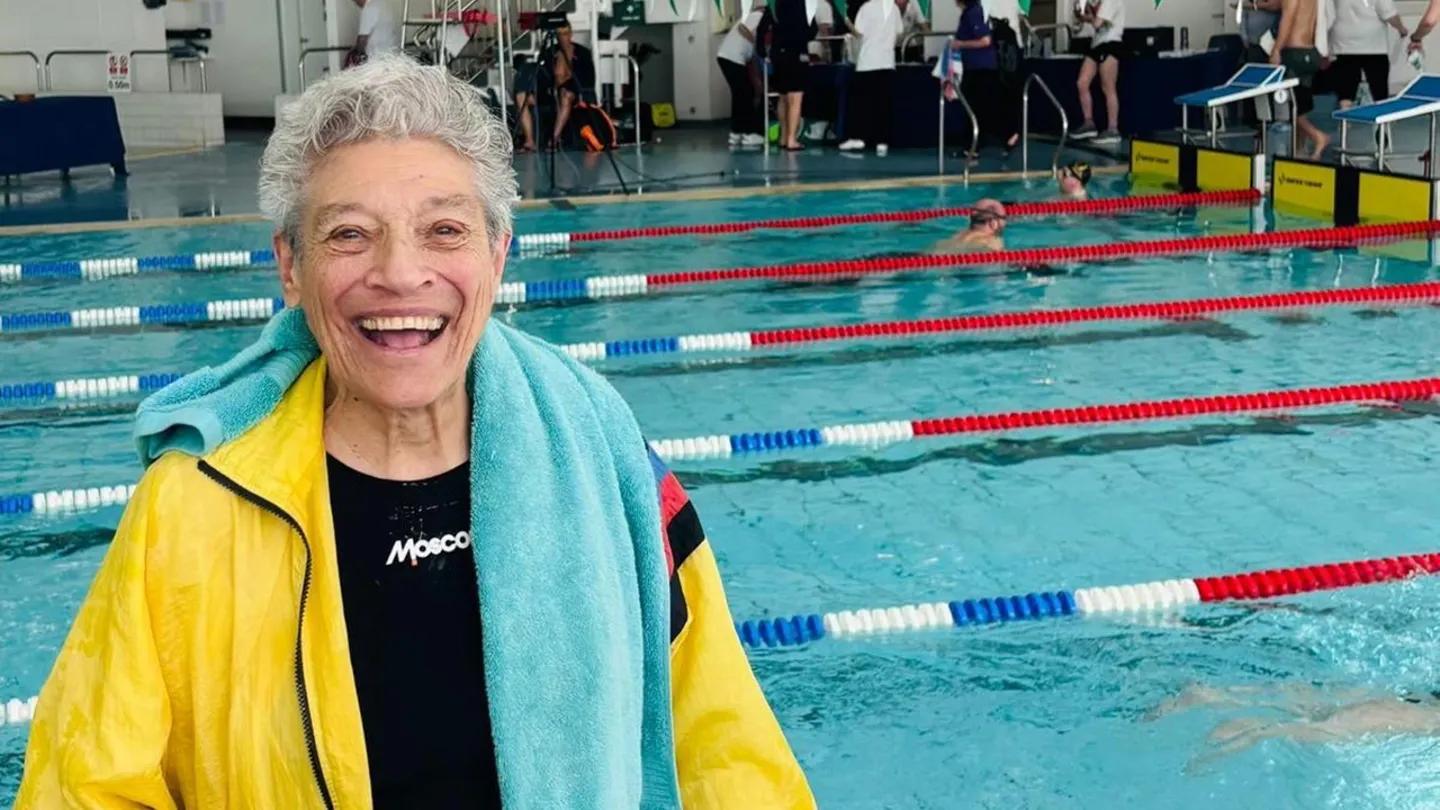
At 95, Jane Asher is still adding records to a career that already spans more than 100 of them. The swimmer from Merton Park in south London recently set five age group world records, adding to a collection that also includes 26 gold medals, a British Empire Medal for her dedication to the sport and a place in the International Swimming Hall of Fame. Looking back on her career, Asher said swimming has played a big part in her health and happiness. “It does keep you healthy. I have taught people who just had surgery and their doctors were amazed by how much they had improved because of the swimming,” she said. “I want to show people what a lot of fun you can have if you like competing and how good you feel when you work hard at something. Sport is very important and quite a lot of youngsters now have put on weight. Swimming doesn’t help you to lose weight but it finds the muscles." “It opened a whole new world for me. It made me happy and healthy.” Asher was born in Zambia, South Africa, and spent most of her childhood in Johannesburg, where her English mother taught her to swim. She said her mother “was addicted to water” and that much of their free time was spent “just jumping in and out of the water”. “My mom was taught to swim in the sea in Cornwall and she was addicted to water. We spent all of our free time just jumping in and out of the water. I took to it quite quickly,” Asher said. Her love of swimming grew at boarding school, where she was allowed to use the pool on her own in the mornings and mostly swam backstroke. “The war was on when I was at school so we didn’t have competitions, but I swam every morning to get rid of some energy,” she said. “In my first race a girl said that I kicked like hell. It was because my mother was watching. Now every time I have a backstroke race I think ‘mom is up there watching.’” Asher, who is a grandmother of 11 and great-grandmother of six, moved around often but always joined local swimming teams. At one point, she even joined a rowing club so she could stay in the water. Later, she married a vet named Robbie. After he had an accident at work, Asher took a job teaching swimming at the local school to help pay the bills. She later moved into teaching adults and started entering masters swimming competitions at 50. By the time she was 80, she had broken 100 records. Her first European record came in an 800 metre race at Crystal Palace, after a wedding where she had a few drinks. Asher competes in several events, but says her favourite is the individual medley, which includes backstroke, breaststroke, front crawl and butterfly. Swimming also helped fill a gap after her husband died, she said. “When my husband died I started filling the time but it was hard because there is this big hole in your life. But swimming has given me such good friends and they give back to me,” she said. “All of my kids are very sporty and I am very proud of them, and I didn’t realise that they are proud of me. Without friends life doesn’t happen. There is always somebody pushing you on. I think that is what keeps me going, somebody waiting for me. I couldn’t do half of what I have done without the friends who have helped me enter. You have to do everything online now. As you get to 95 everything goes so quickly and you get slower.” Asher said younger people should keep active and swim where they can to stay healthy. She also said learning to relax and having a good teacher are important parts of becoming a good swimmer. “It is a really good non-contact sport. You can’t hurt yourself. Running hurts your knees and your hips and even tennis causes shoulder problems,” she said. “I had a good kick with very strong legs and a strong buttocks. “It is good to have something to think about. It is a bit like meditation. That is the secret of course, you must not stiffen up because then you go down like a stone.” Asher is now working towards her next competition and another potential world record in Budapest.

Get even more good news on the free app!
Score (97)
A Teacher Honored This Deaf Student With an ASL Playground Sign That Helps Kids Communicate
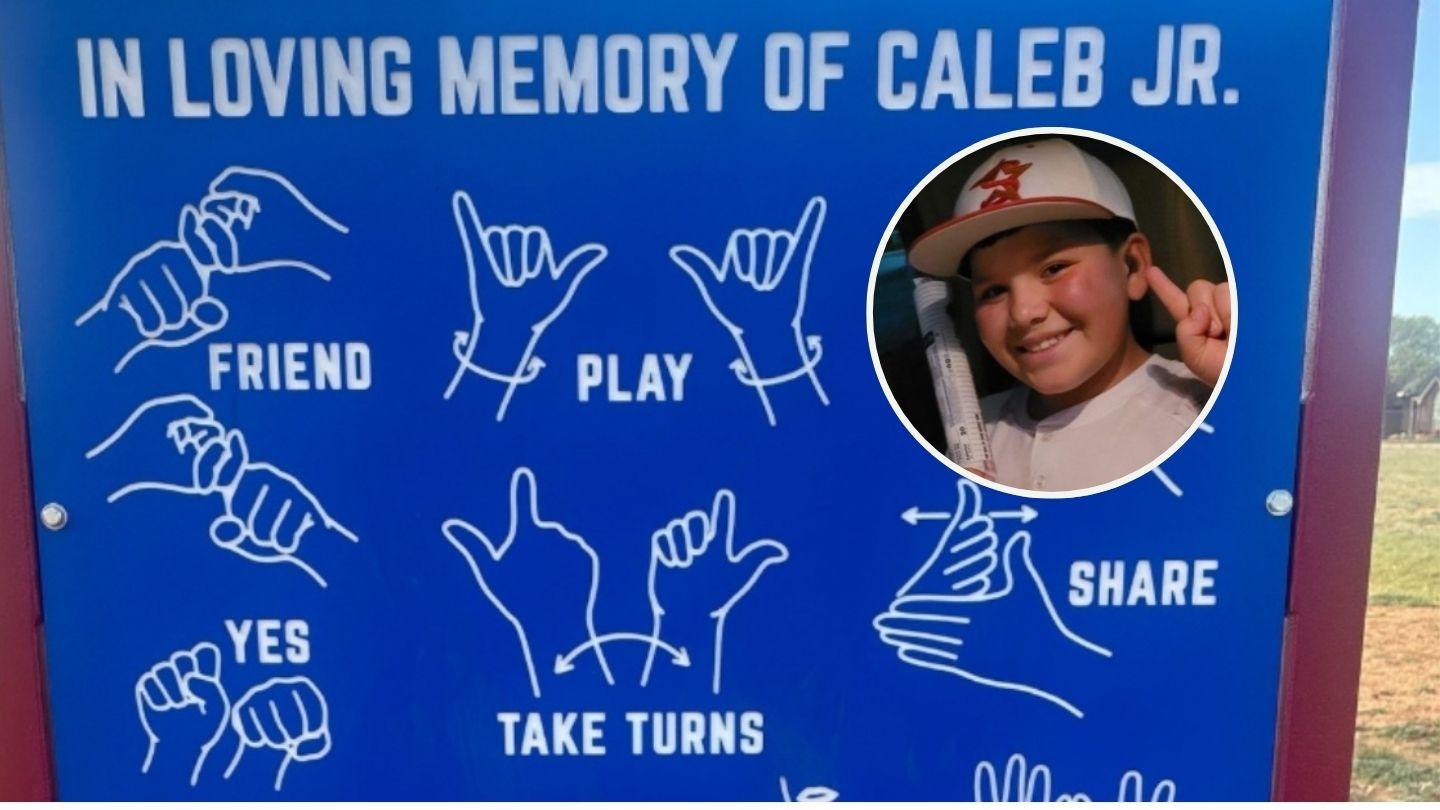
At Ward Elementary in Abilene, Texas, a playground sign is helping children talk to each other, and it carries the name of a boy they still miss. It has been almost two years since 11-year-old Caleb Devereaux Jr., known as “Junior,” died from leukemia. His family, friends and neighbors say his memory has not faded. “He taught me a lot about how to be friendly to everyone, to hearing people and deaf people, and build those friendships, and also to see students as the whole person,” Junior’s former teacher, Letabeth Machogu, told ABC affiliate KTXS12. “Yes, we're learning academics, but we can take time to be fun and be silly, too. Yeah, it's really important. He means a lot to me.” Machogu teaches deaf and hard of hearing students at Ward Elementary, where Junior was one of her students. According to his family, Junior was deaf from an early age, but he quickly learned American Sign Language. His family said that it opened “a world of communication and connection with those around him.” His obituary said, “Junior’s zest for life was evident in everything he did. Whether he was dancing, singing, or creating TikTok videos with his cherished sisters, Makayla and Miyah, his infectious energy and creativity were boundless.” It also said, “His radiant smile could light up any room, and he found immense joy in spending quality time with his family and friends.” A few months before he died, Junior had finished fifth grade. “When I came back after he passed, I was very angry because I just kept thinking that he should be here,” Machogu said. Last summer, Machogu installed a new playground sign at the school inspired by Junior’s playful and outgoing attitude. The sign shows the alphabet in ASL, along with hand signs for words and phrases including “friend,” “play,” “tag” and “share.” Since the sign was installed, hearing students have been able to play more freely with deaf classmates, Machogu told KTXS12. “They can communicate with each other directly with our students who use sign language, and then they can play together without having to have an interpreter there to facilitate all the communication," she said. “They can have a direct friendship without having a third party. You know, that is so important.” At the top of the sign are the words, “In loving memory of Caleb Jr.” “I think he'd be proud,” Machogu said. “I picture him looking at me like, 'Thank you, I love it.' That's what he would say.” The story of the sign lines up with a point made by MJ Grein, an executive assistant at Harvard Medical School’s Countway Library and a former sign language interpreter. According to the Harvard Gazette, Grein said everyone should learn sign language. Even a small number of basic signs can help connect deaf and hearing people, especially for deaf children. “Everyone can learn sign language,” Grein told the Harvard Gazette. “Deaf people can’t learn to hear, and that’s the difference.” At Ward Elementary, Machogu said the sign gives students a way to communicate directly on the playground, the kind of connection she said mattered deeply to Junior. “They can have a direct friendship without having a third party,” Machogu said. “You know, that is so important.” 📸 Credit: Vanessa Rodriguez

Score (97)
First US Pollinator District Opens With a Park Within Walking Distance of Every Home
A suburb built around bees might sound unusual, but that is exactly what is taking shape in Broomfield, Colorado. A mixed-use community called Baseline is being used as a model for a different kind of suburban development, one designed to support pollinators like bees, butterflies, moths and beetles. The idea began in 2019, when nonprofit Butterfly Pavilion set out to build what it calls “pollinator districts,” communities designed and maintained to grow pollinator habitat. These species help produce food and support broader ecosystems. Amy Yarger, director of horticulture at the Butterfly Pavilion, told the Colorado Sun pollinators do much more than move pollen from plant to plant. “They keep wetlands going. They keep our grasslands going. They make sure forests are diverse,” Yarger told the Colorado Sun. “And if they can keep those plant communities healthy and reproducing by assisting plants in their reproduction, that means our water is filtered, and we can hold on to our soil and not just have a big old dust bowl.” Butterfly Pavilion described the thinking behind the project in a blog post. “At Butterfly Pavilion, we believe conservation is strongest when people work together,” the organization writes. “When science, planning, and community commitment align, pollinators respond.” Baseline became the first community in the world to adopt the concept, according to the source text. Other Colorado cities, including Manitou Springs and Lafayette, are committed to the municipal pollinator district effort, but Baseline was the first to fully embrace it. The site itself has changed dramatically over time. It was once agricultural land used for growing wheat and later sat uncultivated. Now it includes 1,200 move-in-ready multifamily units, with prices starting in the low $500,000s. That is slightly below the median sale price for a standard home in Broomfield, which the source text says was between $600,000 and $625,000 in early 2026. The development also includes bike paths and trails, and a “pocket park” is no more than 1,600 feet, or about 0.3 miles, from any home. Every unit meets Home Energy Rating System requirements. The plants used throughout the area are drought-tolerant native species that attract pollinators. In total, 170 acres of the community are dedicated to natural spaces and gardens. Researchers say the habitat work is producing results. Before construction started, scientists documented pollinators from 11 families at the site. By late summer 2025, they had documented pollinators from 27 families. “This marked a significant increase in diversity compared to earlier years and reflected steady growth in both native pollinators and honey bees,” Butterfly Pavilion reported. “Researchers consistently observed pollinators visiting native plants selected for habitat value and recorded broadtail hummingbirds, one of the region’s few vertebrate pollinators, for the first time. Several insect families, including longhorn beetles, plasterer bees, and digger wasps, were also documented at Baseline for the first time.” The source text also says scientists recorded a 272 percent increase in Western honeybees in 2025 compared to the year before. Individual pollinator counts rose from 587 in 2023 to 3,805 in 2025. Yarger told the Colorado Sun that residents appear engaged with what is happening around them. When she is out surveying the community, she said, “homeowners will come outside and want to tell me what they’ve been seeing. They just feel like I’m somebody that has things they want to talk about. They know I’m there for the pollinator district and they have ownership in that.” Those surveys are part of the certification process for pollinator districts. Butterfly Pavilion experts are now applying the same approach to transportation corridors and other communities across Colorado’s Front Range. The process starts with documenting existing conditions and making recommendations on how to manage the area for pollinators. For Yarger, that work points to a practical path ahead. She told the Colorado Sun it makes her feel “like … we have a way forward.” Butterfly Pavilion said the model depends on tracking results over time and adjusting when needed. “This long-term, evidence-based approach mirrors the Pollinator District model developed at Baseline: assess first, design intentionally, monitor consistently, and adapt based on results,” Butterfly Pavilion concluded. “Infrastructure can support biodiversity when guided by science and long-term stewardship.” 📸 credit: Baseline Community

Score (97)
New Study Finds Bumblebees Can Detect Rhythm, Despite Their Tiny Brains
It turns out rhythm is not only for humans, birds and a few other mammals. A new study has found bumblebees can recognise rhythm, the first time scientists have shown that ability in such a small-brained insect. “That’s an unexpected, beautiful finding,” Henkjan Honing, a music cognition researcher at the University of Amsterdam who was not involved in the work, told Christina Larson at Science. Andrew Barron, a comparative neuroscientist at Macquarie University in Australia, and his team wanted to test if an animal with a tiny brain could recognise rhythm. Their findings were published in Science on April 2. In the first experiment, researchers trained bumblebees to forage from artificial flowers fitted with LED lights that flashed in two different patterns. One pattern signalled a reward of sugar water. The other signalled no reward. The bees learned to tell the signals apart. One example was a repeating dash-dot-dash pattern compared with a repeating dot-dot-dash-dash pattern. After researchers removed the reward, nearly all of the bees still preferred the flower that flashed the signal that had previously indicated sugar. The team then sped up the flashing patterns. The bees could still tell the difference between them. “This shows bees had learned a rhythm regardless of tempo, the first evidence that bees had learned a flexible rhythm,” Barron writes in The Conversation. “Imagine you’re listening to a song, and it’s slowed down or sped up, but you can still recognize it,” Cwyn Solvi, a cognitive neuroethologist at Southern Medical University and a study co-author, told Science. “That’s not because you’ve memorized one single detail, but because you’ve grasped the whole structure.” The researchers then tested the bees in a maze with a vibrating floor at the junction. “If it was vibrating dot dash dot dash, it meant turn right to get sugar,” Barron told James Woodford at New Scientist. “So, one rhythm indicated to turn left, one rhythm indicated turn right, and we trained them like that. We showed they could learn that.” Scientists had long thought picking up on rhythm was a skill limited to humans, birds and some other mammals, including chimpanzees. The new study points to a deeper evolutionary root for rhythm sensing, although researchers still do not know how bees do it with such small brains. Barron told Science that the insects’ complex social structure may have shaped the behaviour. “Rhythms are everywhere in a bee’s natural world,” Barron added. “So much of interacting with the world is about pulling out repeating patterns.” The finding adds to a growing list of abilities shown by bumblebees, despite brains about the size of a sesame seed. Previous studies have found bees can do basic maths, understand what “zero” represents and even play soccer. A 2020 study recorded that bumblebees may create mental images of objects. A 2022 journal article also suggested bees like to play with toys. Scientists believe bees have been on Earth for about 130 million years. The oldest fossilised bee is about 50 million years old, but DNA sequencing has allowed researchers to date the origin of bees much earlier. Barron wrote that understanding how bees perform these tasks could help scientists develop technology that lets miniature sensors detect rhythmic temporal structure, “from lightweight solutions to speech and music recognition to diagnosis of heart irregularities, or pre-epileptic brain waves”. “That an organism like a bee, with a bee-type brain, is able to abstract a rhythm is remarkable,” Barron told New Scientist. Photo by SANJAY SHARMA on Pexels (https://www.pexels.com/photo/honey-bee-pollinating-yellow-flowers-close-up-31844608/)
Score (97)
They Created a Breath Sensor That Detects Pneumonia in Minutes, Without X-Rays or Lab Tests
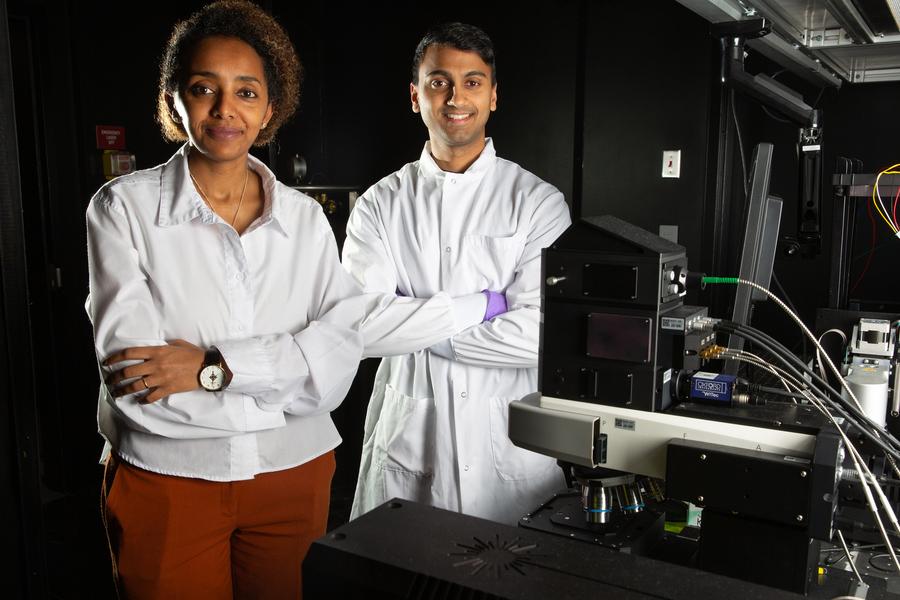
A chest X-ray and lab test might not always be the first stop for checking pneumonia in the future. Researchers at MIT have developed a portable sensor prototype that they say could detect pneumonia and other lung-related diseases from a person’s breath. The device, called PlasmoSniff, has so far only been tested in mice, not humans, but the team says it could eventually offer a faster way to pick up signs of disease without relying on laboratory-grade electronics typically found in hospitals. The system starts with nanoparticles that a patient inhales. When those nanoparticles are later exhaled, they carry attached biomarkers that can show evidence of disease from deep inside the body. “In practice, we envision that a patient would inhale nanoparticles and, within about 10 minutes, exhale a synthetic biomarker that reports on lung status,” mechanical engineer Aditya Garg said. “Our new PlasmoSniff technology would enable detection of these exhaled biomarkers within minutes at the point of care.” The nanoparticles used in the system have been in development for several years. The biomarkers, or chemical tags, attached to them break away when they come into contact with specific protease enzymes linked to certain diseases. That gives researchers a signal to track. The challenge is that those biomarkers are exhaled only in very small amounts. To pick up those traces, the new sensor uses plasmonics, the study and manipulation of light. That is where the name PlasmoSniff comes from. More specifically, the sensor uses Raman spectroscopy, a technique that uses light to measure the vibrations of a molecule. Those vibrations act as signatures for the movement of atoms within chemical bonds, allowing researchers to identify molecules. The sensor uses gold nanoparticles suspended over a thin gold film. The team says gold is an ideal metal for plasmonics. Inside the sensor, water-coated microscopic gaps trap the target biomarkers and amplify their vibrations enough for the device to detect them. Human breath contains volatile organic compounds, or VOCs, that can show everything from the state of the gut microbiome to how efficiently the body’s metabolic processes are running. But the newly designed sensor is built to isolate only a very small fraction of the chemicals a person exhales. “This is a needle-in-a-haystack problem,” mechanical engineer Loza Tadesse said. “Our method detects that needle that would otherwise be embedded in the noise.” For now, the research remains at the prototype stage. The team tested the sensor in mice rather than people, and it looked for only one specific biomarker. The next steps are more complicated. The researchers say testing on human breath will be harder, and they still need to build a mask-like attachment that can analyse a patient’s breath over about five minutes. That mask would work with a device similar to an asthma inhaler, which would deliver the nanoparticles into the body. In healthy people, the nanoparticles would simply circulate out of the body without being broken down by disease. The researchers say that if development and scaling go well over the coming years, the technology could become a new option for monitoring and detecting disease. They also say it could be adapted for a wide range of uses beyond respiratory conditions such as pneumonia. Tadesse said the platform may also have uses outside human health in situations where portable sensors need to detect small traces of chemicals in the air. “It’s not just limited to these biomarkers or even diagnostic applications,” Tadesse said. “It can sniff out industrial chemicals or airborne pollutants as well. If a molecule can form hydrogen bonds with water, we can use its vibrational fingerprint to detect it. It’s a pretty universal platform.” The research has been published in Nano Letters.
Score (97)
Jackie and Shadow Bald Eagle Egg Starts Hatching After Big Bear Nest Loss
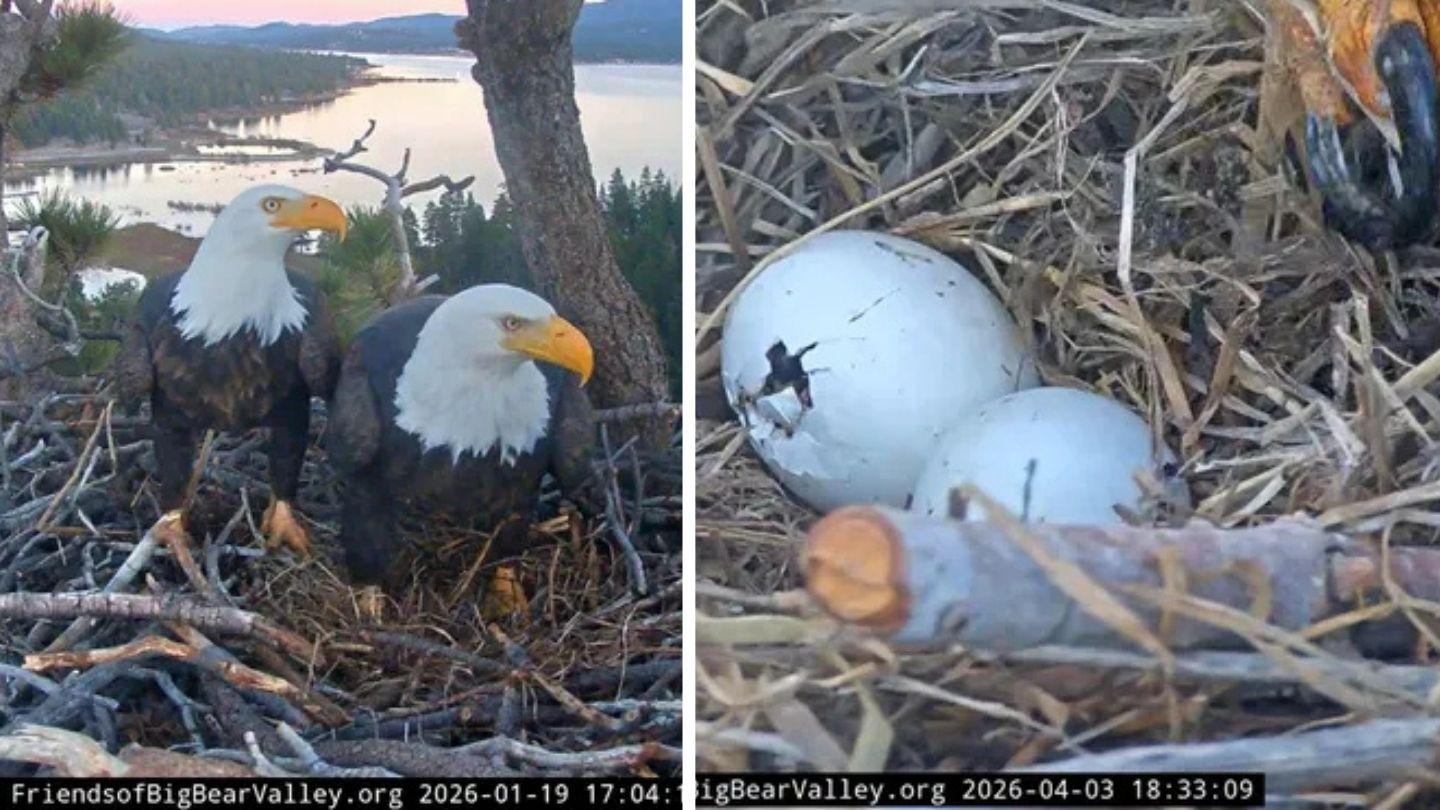
After weeks of watching and waiting, there is finally a sign of movement in Jackie and Shadow’s nest. One of the eggs being guarded by the well-known California bald eagle pair is in the process of hatching, according to Friends of Big Bear Valley, the nonprofit that monitors a live feed of the birds. In a Facebook post on April 3, the group said little chirps were heard from the nest during the afternoon and evening of April 2 and throughout the night. The organization said the sounds indicated one of the chicks could “break the internal membrane and (take) its first breath of air.” Footage posted by the nonprofit on April 3 showed a crack in the egg. The baby eagle has not fully hatched yet. Friends of Big Bear Valley said it can take another 24 to 48 hours for the chick to come out of its shell. Jackie and Shadow have one other egg that has not hatched, but it should also be due any day. “It’s getting egg-citing!!,” the nonprofit said. “Thank you for being with us on this amazing journey!” The pair has been guarding the eggs for more than a month. Earlier this year, Jackie and Shadow lost their first clutch of eggs laid during the 2025-2026 breeding season after ravens breached their nest in January. They laid the current eggs on Feb. 24 and Feb. 27. Jackie and Shadow became widely known during the 2017-2018 mating season through their 24-hour livestream nest cam overlooking Big Bear Lake in the San Bernardino Mountains. The couple had their first chick, Spirit, in 2022. In 2025, they had two eaglets, Sunny and Gizmo. The livestream of the birds is available on the Friends of Big Bear Valley website.
Score (98)
High School Teens Repair Used Cars to Donate Reliable Transportation to Single Moms
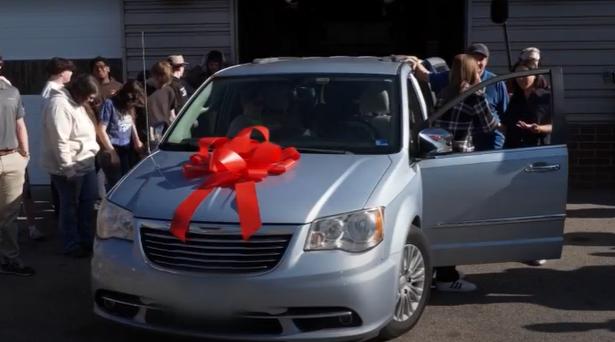
In one Virginia auto shop, the cars are headed somewhere simple and life-changing: to single mothers who need a way to get to work, school and medical appointments. At Louisa County High School near Richmond, a group of students has been repairing used cars that are then given to local single moms. The students are part of a trade program tied to a partnership between the school and a local non-profit, Giving Words, which fixes used cars and donates them at no cost. Giving Words was founded in 2018 by Eddie Brown and his wife, Ginny. Brown said the couple came to understand that single mothers needed help in several areas, and transportation rose to the top. "What we learned was transportation was the first thing," Brown said to Today. "Without transportation, you don’t have access to a job, you don’t have access to education, you don’t have access to medical needs." What began in Brown's driveway has since grown across Virginia. Brown said the charity has received more than 60 donated cars to date. Giving Words also works with local dealership Carter Myers Automotive to coordinate the donated vehicles. Now, students, including Owen Yarrington and Stephen Smith, are among those helping get the donated cars back on the road. For Smith, the work carries real pressure because someone else will depend on the vehicle being safe to drive. "So it is a lot of pressure because you had to do it right and you have to make sure everything’s torqued to spec so nothing falls apart," Smith said. Even with that pressure, Smith said the work is also enjoyable. "It's a lot of fun too," Smith said. Yarrington said the handover moments stay with the students, especially when they see what the cars mean to the women receiving them. "When they tear up and cry it makes you want to tear up and cry," Yarrington said. The students are guided by Shane Robertson, a teacher who once walked the same halls as a student in the program. Robertson said he knew back in high school that he wanted to become an auto teacher, and he said he understands the meaning a car can carry beyond the parts that make it run. "It’s not just a car," Robertson said. "It’s not just nuts and bolts. It’s literally the difference between someone making it and someone not." That difference was about to become real for Jessica Williams, a single mother of three who was next to receive a free car. Williams had been trying to support her family while working as a grocery store cashier. She said the vehicle opens up new options for her future, including more schooling, better work and more time with her children. "I can further my education now," Williams said. "I can go to college, I can get a better job. Just all of it, more time with my family." She also thanked the people behind the effort, including the students who helped repair the car. "So many people had a part in this and I’ll never forget it," Williams said. The program brings together students learning a trade, a non-profit built around donated cars and mothers who need reliable transportation. Brown said the charity grew from a driveway project into a statewide effort, with more than 60 donated cars received so far. The students at Louisa County High School are part of that work, repairing vehicles that Giving Words then gives away for free. For Smith and Yarrington, the task comes with pressure and emotion. For Robertson, it reflects what a car can mean. For Williams, it means a shot at college, a better job and more time with her family. 📸credit: TODAY

Score (95)
Warren Buffett and Stephen Curry Revive Charity Lunch to Raise Millions for Good Causes
Warren Buffett is bringing one of his best-known charity events back, after four years away, with a different cast around the table this time. Buffett, who turns 96 this summer, is reviving his annual charity lunch and teaming up with the Eat. Learn. Play. Foundation, a Bay Area nonprofit founded by NBA star Stephen Curry and his wife, Ayesha Curry. Buffett started the lunch in 2000 to benefit San Francisco’s GLIDE Foundation, a social justice nonprofit focused on fighting poverty and inequality. Aside from two pandemic years, he kept the event going until 2022, helping raise more than $54 million over two decades. The highest winning bid came in 2022, when an anonymous donor paid a record-breaking $19 million. After Buffett stepped back, Salesforce CEO Marc Benioff continued the event, raising $1.5 million for GLIDE in 2024. Buffett is now returning to host his first charity lunch since retiring as Berkshire Hathaway CEO in 2025. Bidding for the 2026 lunch opens on eBay on May 7. The winning bidder, along with seven guests, will join Buffett and the Currys for a private event in Buffett’s hometown of Omaha, Nebraska, on June 24. The format is also changing. In the past, the lunch focused mainly on Buffett. This year, it will center on a multigenerational discussion between Buffett and the Currys. Stephen and Ayesha Curry founded Eat. Learn. Play. in 2019. The foundation provides schoolchildren in Oakland, California, with nutritious meals, educational tools and sports opportunities. Proceeds from this year’s event will be split between GLIDE and Eat. Learn. Play. Buffett said he first paused the lunch when he “ran out of gas” at age 92. He told CNBC that the recent death of GLIDE co-founder Reverend Cecil Williams helped prompt the return. “All he wanted was this to continue,” Buffett told CNBC this week. Buffett also said this year’s version is meant to bring in a younger partner who can help carry the event forward alongside the Currys. He is also adding a personal donation. Buffett said he will match the winning bid himself, with his contribution divided equally between GLIDE and Eat. Learn. Play. Chris Helfrich, president and CEO of the Eat. Learn. Play. Foundation, said the new partnership broadens the event’s reach. “What’s so powerful about this moment is that it honors everything Warren has built while opening the door to what philanthropy can look like going forward,” Helfrich told Observer. “By bringing Stephen and Ayesha into it, that impact expands in a very real way. It introduces new energy, new audiences and ultimately increases what we’re able to do for the communities we support.” Buffett also praised the Currys’ work in Oakland. “They have a deep and sustained interest in helping the children of Oakland enjoy better futures and, in a big way, have given life to that belief,” Buffett told CNBC. “Stephen has not sought plaudits or, on any scale, funding from others.” Previous lunches were often held at Smith & Wollensky Steakhouse in New York City and included GLIDE leaders. This year’s event will instead be held at an Omaha location selected by Buffett, which has not yet been disclosed. Past winners of the auction include Chinese crypto entrepreneur Justin Sun and hedge fund manager Ted Weschler. Weschler later joined Berkshire Hathaway as an investment manager after winning in 2011. Online bidding for the 2026 lunch starts on May 7 at 7:30 p.m. PT and closes on May 14 at the same time. Interested bidders must complete a prequalification form that includes their name, address, occupation, social media handles and group affiliations. Bidding opens at $50,000, though past auctions have routinely topped $1 million. "Steph Curry (51915156704)" by Erik Drost is licensed under CC BY 2.0 (https://creativecommons.org/licenses/by/2.0/)

Score (98)
Japan Diaper Recycling Program Turns Used 'Nappies' Into New Products and Cuts Landfill Waste
Dirty diapers are not the kind of waste most places want to talk about for long. In southern Japan, two municipalities have spent years figuring out how to recycle them. In the 1990s, the Japanese municipalities of Shibushi and Osaki estimated that the landfill they shared would be full by 2004. Unless they cut the size of their waste streams, they would need to give up more land for rubbish or send waste much farther away to another site. Their response was to step up recycling in the clearest categories first, including glass, paper and metals. After that, they moved on to harder waste streams, including used diapers. “Ultimately, our top priority is to reduce our trash and extend the life of the landfill,” Kenichi Matsunaga, an environment official for the city of Shibushi, told the Japan Times. Billions of diapers used by babies and older people are thrown away every year in Japan. They are made of layered, super-absorbing fibres and other materials, and they are not easily recyclable. A new diaper recycling initiative in Kagoshima Prefecture separates and shreds the core material in a way that prepares it for reuse, while saving millions of tons of waste from going to landfill. Shibushi and nearby Osaki recycle 80 percent of household waste, about four times the national average. The company Unicharm set out to pioneer its diaper recycling method there, in places where residents are already used to sorting rubbish. The diapers are collected from residents, but only if names are written on the bags for accountability. After collection, the diapers are washed and shredded until their plastic, pulp and super-absorbent polymer, or SAP, are separated. The company has already used the recycled material to make toilet paper. It has now advanced its method and machinery enough to reuse the pulp in diaper manufacturing. The process uses ozone, a sterilising gas, to clean and deodorise the pulp until it meets sanitary requirements. The company is still working on ways to prepare the SAP for reuse and expects progress by 2028. Japan is probably the only country in the world where more diapers are produced for incontinent older people than for babies. Those products are larger and more robust, and they take up more room in landfill. Japan wants 100 cities and towns to be recycling diapers by 2030, or at least to have started talking about it, the Japan Times reported. The push in Shibushi and Osaki grew out of a simple problem: landfill space was running out. Their answer started with the easiest materials to sort and then moved into a category that is harder to process and far less pleasant to handle. That has made the diaper initiative part of a much wider recycling effort. In Shibushi and Osaki, the high recycling rate meant Unicharm could test the system in communities where household sorting was already part of daily life. The method focuses on breaking diapers down into the materials that make them useful in the first place. Plastic, pulp and SAP are separated after washing and shredding, and the pulp is cleaned with ozone so it can be reused. For now, the company has taken the pulp the furthest. It has already turned that material into toilet paper, and it has now developed the process enough to put the pulp back into diaper production. Work on the super-absorbent polymer is still continuing, with progress expected by 2028. The scale of the waste helps explain the effort. Billions of diapers are thrown away every year in Japan, and the country produces more diapers for incontinent older people than for babies. Those products are bigger, stronger and take up more space in landfill. For Shibushi and Osaki, the target has remained the same since the landfill warning in the 1990s. As Matsunaga put it, “Ultimately, our top priority is to reduce our trash and extend the life of the landfill.”